Introduction: Why Precision Relies on Granite
In the realm of modern precision engineering, the "chassis" of your equipment dictates the absolute ceiling of its accuracy. As a natural igneous rock, granite has become an irreplaceable structural foundation. Its exceptional mechanical stability, ultra-high hardness, minimal thermal expansion, and excellent corrosion resistance make it the ultimate material for demanding environments.
Whether you are manufacturing heavy-duty CNC machine beds, ultra-precise optical structural components, or dynamic motion control bases, the demands for dimensional stability and vibration dampening are rigorous. But not all granite is created equal.
In this technical overview, we systematically evaluate three top-tier granite materials: Jinan Black, India Granite, and Africa Black. By comparing their chemical compositions and physical-mechanical properties, this guide bridges material science with practical applications to help you make the best structural choices for your equipment.
I. The Contenders: A Quick Overview
Before diving into the hard data, let's meet the three heavyweights of the precision manufacturing world:
Jinan Black Granite (China): The classic industry standard. Renowned for its uniform texture and massive mechanical strength, it has been the reliable backbone of domestic and international precision equipment for decades.
India Granite: The premium imported choice. Globally recognized for its extreme hardness and near-zero water absorption, it is the go-to material for high-precision optical and mechanical components.
Africa Black Granite: The high-performance dynamic base. Valued for its stable thermal expansion and high elastic modulus, it excels in high-load, high-speed motion control systems.
II. Deep-Dive Analysis: Which Granite Fits Your Needs?
Different equipment faces different physical challenges. Here is how these materials perform based on laboratory data and real-world applications:
1. Jinan Black Granite: The Heavy-Duty Anchor
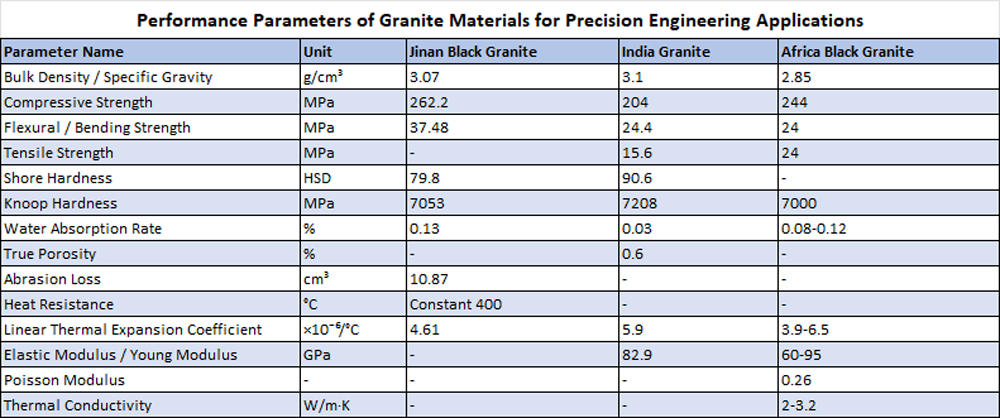
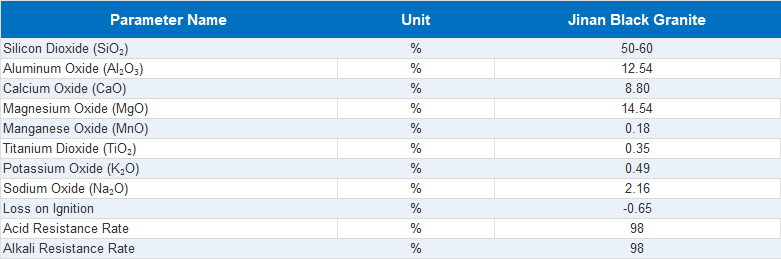
The Science: Boasts the highest compressive strength (262.2 MPa) and flexural strength (37.48 MPa) of the three. It features exceptional chemical resistance (98% for both acid and alkali) and maintains stability at high temperatures (up to 400°C).
The Translation: Simply put, Jinan Black is the "muscle" of granites. It can bear immense weight and withstand continuous, violent vibrations without cracking. Furthermore, its chemical resistance means it won't degrade in harsh manufacturing environments exposed to industrial coolants or lubricants.
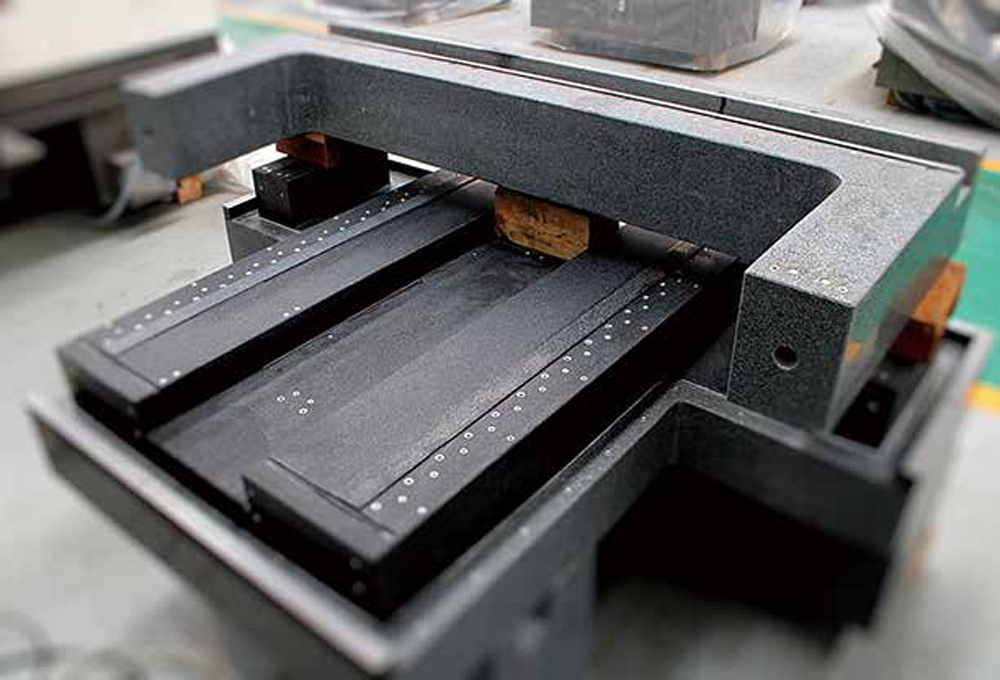
Ideal Application: Main bodies and bases of heavy-duty CNC engraving machines. When your large-scale equipment needs to endure heavy loads and vibration impacts over years of operation, Jinan Black ensures the foundation never compromises.
2. India Granite: The Micro-Precision Guardian
The Science: Stands out with an ultra-high Shore hardness (90.6 HSD), high bulk density (3.10 g/cm³), and a shockingly low water absorption rate (0.03%).
The Translation: India Granite’s superpower is its immunity to environmental changes. A 0.03% water absorption rate means it is practically waterproof—it will not swell, warp, or suffer micro-deformations in humid factories. Combined with its extreme surface hardness, it offers unmatched resistance to wear and tear.
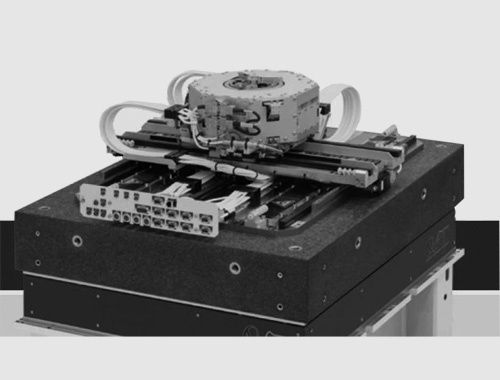
Ideal Application: High-precision guide rails, positioning components, and fine structural parts. For components where a deviation of a few micrometers is unacceptable, India Granite provides long-lasting, wear-resistant dimensional accuracy.
3. Africa Black Granite: The Thermal Shield & Shock Absorber
The Science: Features an incredibly stable linear thermal expansion coefficient (3.9-6.5 ×10⁻⁶/°C) and a high elastic modulus (60-95 GPa).
The Translation: High-speed motion generates friction (heat) and vibration. Africa Black acts as both a "thermal shield" and a "shock absorber." Its low thermal expansion means the material won't warp when the machine heats up. Meanwhile, its high stiffness (elastic modulus) naturally dampens high-frequency vibrations, keeping the moving parts stable.
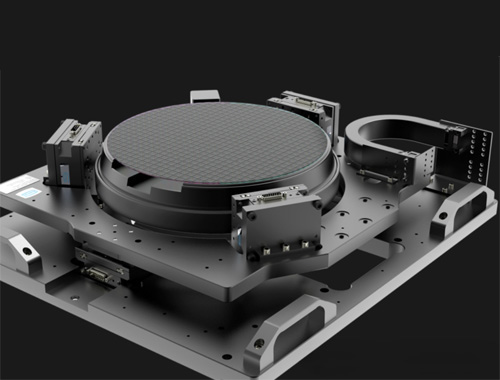
Ideal Application: Bases for high-speed, high-precision motion control systems and advanced machine tools. It suppresses operational judder, drastically improving dynamic positioning accuracy and processing stability.
III. Conclusion: Match the Material to the Mission
When it comes to precision engineering, there is no single "perfect" material—only the perfect match for your specific engineering challenges.
Selecting the right granite foundation is the most critical step in maximizing processing accuracy, operational stability, and equipment lifespan.
Ready to build a better foundation for your machinery?
Contact our engineering team for customized granite selection and precision manufacturing solutions tailored to your specifications.