Prologue: The Simplest Design Problem in the World
Imagine you are tasked with designing a tie rod for a precision motion system. Your design constraints are straightforward: the stiffness must be ≥ktarget ,the weight must be as light as possible, and the length L is fixed. You are free to choose any material and adjust the cross-sectional area A as you see fit.
It sounds almost ridiculously simple, doesn't it? Yet, the answer to this elegant puzzle forces two fundamental material properties—Young's Modulus (E) and Density(ρ)----to merge into a single, ultimate metric that will be placed right in front of you: E/ρ.

Figure 1: The Physical Origin of Specific Stiffness — Naturally emerging from the tie-rod design problem.
Part I. The Full Derivation: From Hooke's Law to E/ρ
1.1 Hooke's Law: Where It All Begins
Let's look at a uniform rod with length L and cross-sectional area A, subjected to an axial pulling force F at both ends [1].
Enter Hooke's Law (the stress-strain relationship at the material level):
σ=E⋅ε
Stress (σ): σ=F/A — The internal force distributed over a unit of cross-sectional area.
Strain (ε): ε=δ/L — The amount of elongation per unit of length.
Young's Modulus (E): An inherent property of the material representing its ability to resist elastic deformation.
Substitute these into Hooke's Law:
F/A=E·(δ/L)
By rearranging the terms, we establish a direct relationship between the external force F and the elongation δ:
F = (EA/L) · δ
This equation takes the familiar form of F=k·δ.The proportionality constant k is the Stiffness—the force required to achieve a unit of elongation:
k = EA/L
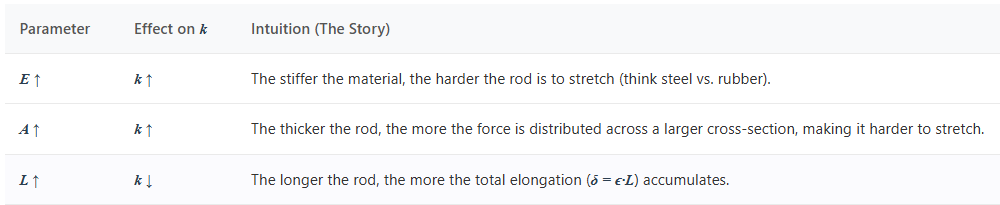
Physical Intuition:
1.2 The Mass of the Rod
The mass of this exact same rod is [1]:m=ρAL.Where ρ is the density.
Up to this point, we have two equations and four variables (E,ρ,A,L) alongside our design targets (K,m). Notice that A appears in both K and m. This means material selection and cross-section sizing are inextricably coupled through A.This is the fulcrum of the entire problem.
1.3 Eliminating A: Given a Target Stiffness, Find the Lightest Material
Our design constraint is k≥ktarget.To meet this stiffness, the minimum cross-section required is:

The mass corresponding to this minimum cross-section is:
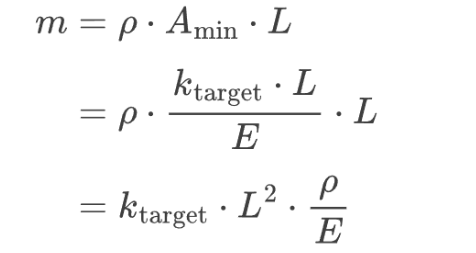
Here, ktarge and L2 are fixed design requirements—they won't change regardless of the material you pick. The only part that changes with your material selection is ρ/E:
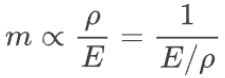
Conclusion: Under a given stiffness constraint, the mass of the rod is inversely proportional to ρ/E. Higher E/ρ, Lighter rod.
1.4 Eliminating A: Given a Target Mass, Find the Stiffest Material
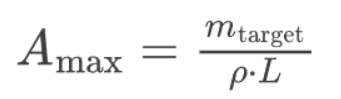
Let's flip the scenario. The constraint is m ≤ mtarget. The maximum allowable cross-section is:
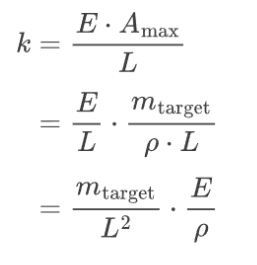
The stiffness we can achieve with this section is:
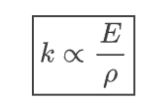
Conclusion:Under a given mass constraint,the achievable stiffness is directly proportional to E/ρ.Higher E/ρ,Stiffer rod.
1.5 Summary of the Derivation
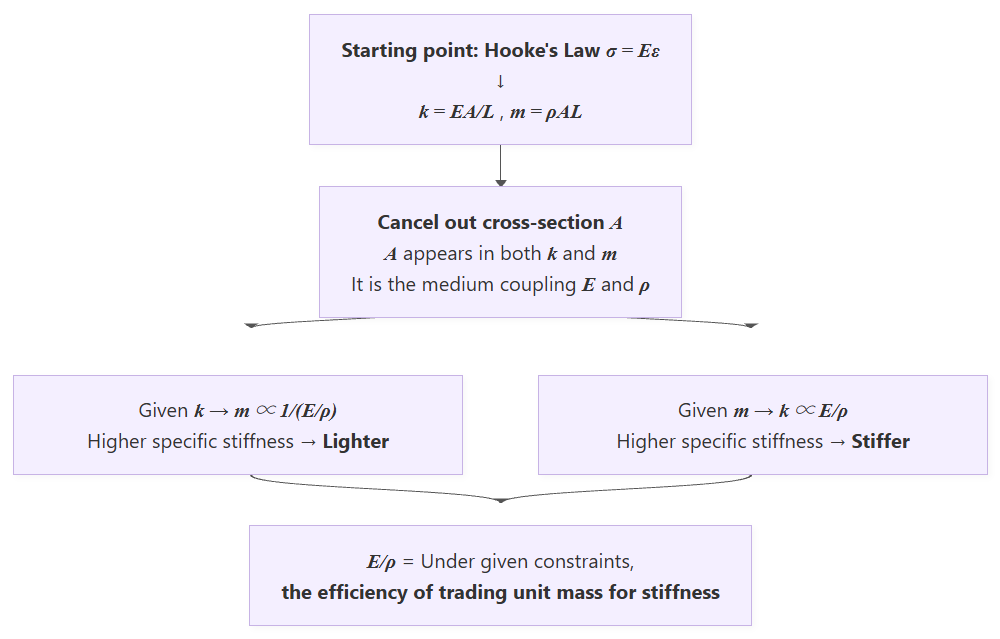
Figure 2: The complete logical chain for deriving specific stiffness—a journey that begins with Hooke's Law, proceeds to cancel out the cross-sectional area, and ultimately leads to the natural emergence of E/ρ.
Part II. Natural Frequency: The Ultimate Form of Specific Stiffness
While the tie-rod derivation answers "which is lighter?" and "which is stiffer?", E/ρ holds a much more fundamental identity, especially for motion control in mega-science facilities where vibration is the enemy.
2.1 The Single Degree-of-Freedom Spring-Mass System
Consider the simplest vibration model [2]:
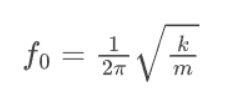
Substitute k = EA/L and m = ρAL into the equation:
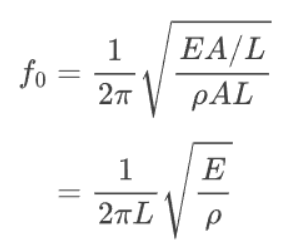
Notice how A is completely canceled out inside the square root. The cross-sectional shape and size—essentially the entire geometric world—vanish from the f₀ formula.
2.2 The Physical Meaning
The term√(E/ρ) has a highly specific physical identity: it is the propagation speed v of longitudinal waves (stress waves) inside a material, measured in m/s [3]:
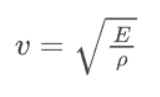
For aluminum, E/ρ = 25.6×10⁶ m²/s² → v ≈ 5060 m/s. This is the speed of sound through aluminum. If you tap one end of an aluminum rod, the stress wave travels to the other end at exactly this speed.
The true essence of Specific Stiffness (E/ρ = v²) is the square of the mechanical wave propagation speed within the material. Faster wave propagation → Shorter round-trip time for a disturbance inside the structure → Higher natural frequency.
2.3 Clarifying a Classic Myth: Do Steel and Aluminum Have the Same f₀ ?
Steel has an E = 193 GPa, while Aluminum's E = 69 GPa—steel is 2.8 times stiffer. So why do a steel rod and an aluminum rod of the exact same dimensions have virtually identical natural frequencies?
Because f₀ ∝ √(E/ρ), not ∝ √(E). Steel's density is ρ = 8000 kg/m³, and Aluminum's is ρ = 2700 kg/m³—steel is roughly 3 times heavier. Since E increases by 2.8x and ρ simultaneously increases by 3x, the ratio √(E/ρ) remains almost unchanged.
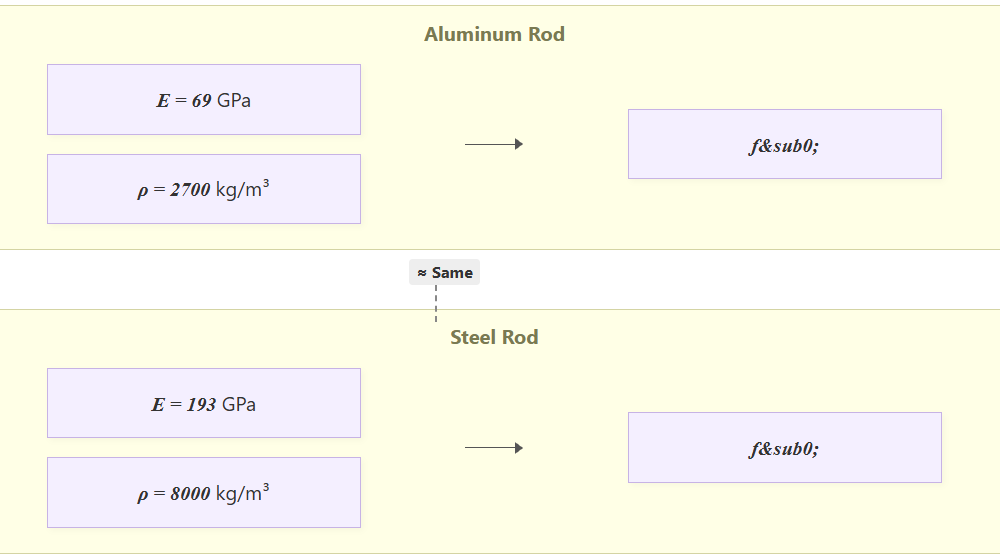
Figure 3: Why steel and aluminum have nearly identical natural frequencies—their E and ρ rise and fall in tandem, keeping their specific stiffness exactly the same.
This is precisely why many engineers are utterly shocked the first time they realize that "Steel = Aluminum" in terms of specific stiffness—but the math doesn't lie.
Part III. How to Correctly Read Specific Stiffness Data
3.1 The Comprehensive Material Specific Stiffness Table
Data sources: Yoder [1], Vukobratovich [4], Ashby [5], and public datasheets from Schott and Corning.
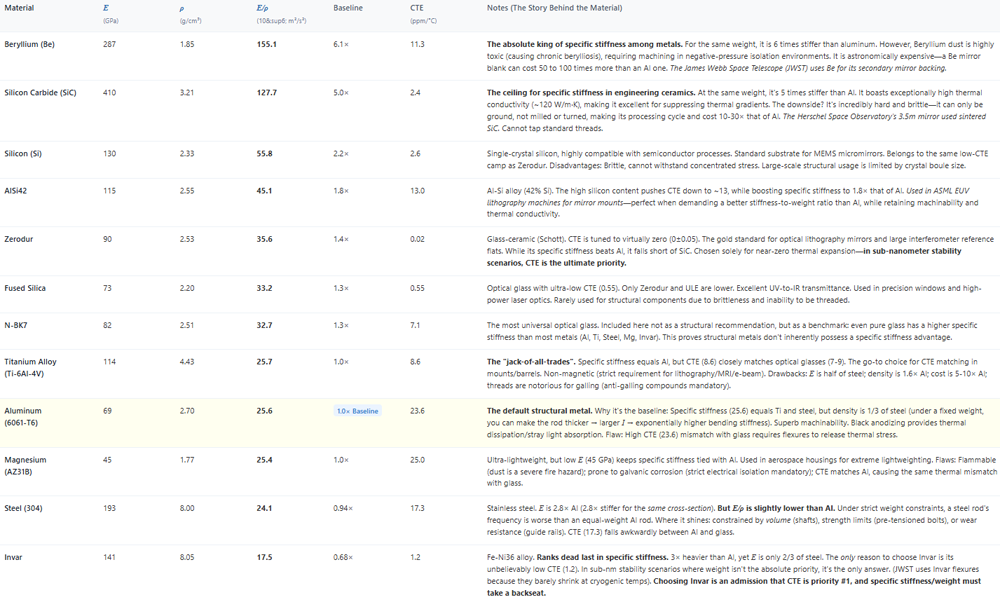
Memorizing the key values in this table installs an "intuition operating system" in your brain. Whenever you look at a material, you will automatically map its position across three coordinates: stiffness, weight, and thermal expansion.
3.2 Three Things You'll Get Wrong at First Glance (Broken Down)
Myth 1: "Steel and Aluminum have similar specific stiffness, therefore Steel is useless."
The fatal flaw in this logic is equating "similar specific stiffness" with "materials are interchangeable." Specific stiffness only answers one question: Assuming equal mass, which is stiffer? It cannot answer two other critical questions:
1)When cross-sections are fixed: If a shaft must adhere to a standard φ20mm specification, A=π·10² mm² is locked. Here, Since steel's(k = EA/L ∝ E)E is 2.8x higher thanaluminum's, the steel shaft will be 2.8x stiffer. Weight? It will be heavier, but since you can't change the cross-section, E/ρ has no say in this scenario. Pure E rules.
2)When strength is the priority: Threaded holes enduring high preload forces are a prime example. Aluminum threads strip easily (shear strength is ~1/3 of steel), whereas steel threads can be repeatedly assembled without failing. This is a matter of strength,not stiffness. Specific stiffness governs the stiffness-to-weight ratio,not thread pull-out resistance.
3)Wear resistance: For guide rails, bearing housings, and locating pin holes, steel's hardness far exceeds aluminum's. Over time, aluminum holes wear out (losing tolerance), while steel remains pristine.
Steel's irreplaceability lies outside the specific stiffness table—it shines in strength, wear resistance, high-temperature endurance, and geometrically constrained spaces. Treating specific stiffness as the sole scorecard for a material is like judging a person's entire worth based solely on their height.
Myth 2: "Aluminum, Titanium, and Steel have similar specific stiffness, so swapping them is meaningless."
This myth falsely assumes that materials are swapped only to improve specific stiffness. While it's true they tie in the "equal weight stiffness" race (24~26), material selection is profoundly multi-dimensional:
1)If the constraint is CTE (Coefficient of Thermal Expansion): Titanium (8.6) closely matches optical glass (7~9), while Aluminum (23.6) is off by a factor of 3. For a mirror mount directly touching a lens, Titanium beats Aluminum—not because of specific stiffness, but due to thermal matching.
2)If the constraint is Magnetism: Both Titanium and Aluminum are non-magnetic (paramagnetic/diamagnetic), whereas steel is strongly ferromagnetic. If you use steel bolts in the electron-beam deflection system of a lithography machine, the magnetic field will distort the electron trajectory, ruining overlay accuracy. This isn't a specific stiffness issue; it's basic physics.
3)If the constraint is Cost: Aluminum raw material and machining cost 1/5~1/10 that of Titanium. For consumer electronics producing millions of units annually, a tiny price gap multiplies into hundreds of thousands of dollars. Same specific stiffness, vastly different cost, entirely different decision.
Summary: A tie in specific stiffness does not mean materials are equivalent. CTE, magnetism, cost, machinability, and corrosion resistance can independently become the decisive factor. Specific stiffness is just the first coarse filter.
Myth 3: "SiC is 5 times better than Aluminum → It's always worth using."
Silicon Carbide (SiC) indeed boasts an E/ρ 5 times greater than aluminum—there is zero debate on this single dimension. However, translating this number directly into "SiC is 5x better" is a massive leap in engineering judgment.
1)SiC is hard and brittle: Its Mohs hardness is ~9 (close to diamond), compared to Aluminum's 2.53.Aluminum can be swiftly turned, milled, drilled, and tapped using standard carbide tools. A well-designed aluminum precision mount can go from raw block to finished part in a day. SiC requires grinding with diamond wheels, removing material layer by painful layer. Machining is 1/20~1/50 the speed of aluminum, and costs 10~30 times more.
2)SiC cannot be tapped: Drilling and tapping an M6 thread in aluminum takes minutes. Drilling SiC requires diamond bits, and tapping is practically impossible (the tap will shatter). Therefore, connecting SiC structures requires embedding metal threaded inserts or using adhesives—adding process steps and potential failure modes.
3)SiC has terrible fracture toughness: When overloaded, aluminum yields (plastic deformation)—it bends, giving you a visible warning. SiC transitions straight from elastic to catastrophic brittle fracture with zero warning. Consequently, SiC structures demand a much higher safety factor (typically 4~6 vs. 1.5~2 for aluminum), which artificially drives up weight and cost.
When is SiC actually worth it? Only when weight and stiffness are simultaneously pushed to absolute physical limits. Think space telescopes: launch costs are tens of thousands of dollars per kilogram, and the mirror's self-weight deformation directly dictates image quality. Here, SiC's 5x specific stiffness advantage and dimensional stability in a zero-gravity environment completely override its manufacturing drawbacks.
For a precision optical mount in a ground-based lab where aluminum suffices, using SiC is pure Over-Engineering. The question isn't whether "SiC is good," but rather "Is it the optimal solution within your specific set of constraints?"
Part IV. The Three Core Roles of Specific Stiffness
4.1 The First Filter in Material Screening
The correct sequence for material selection [5]:
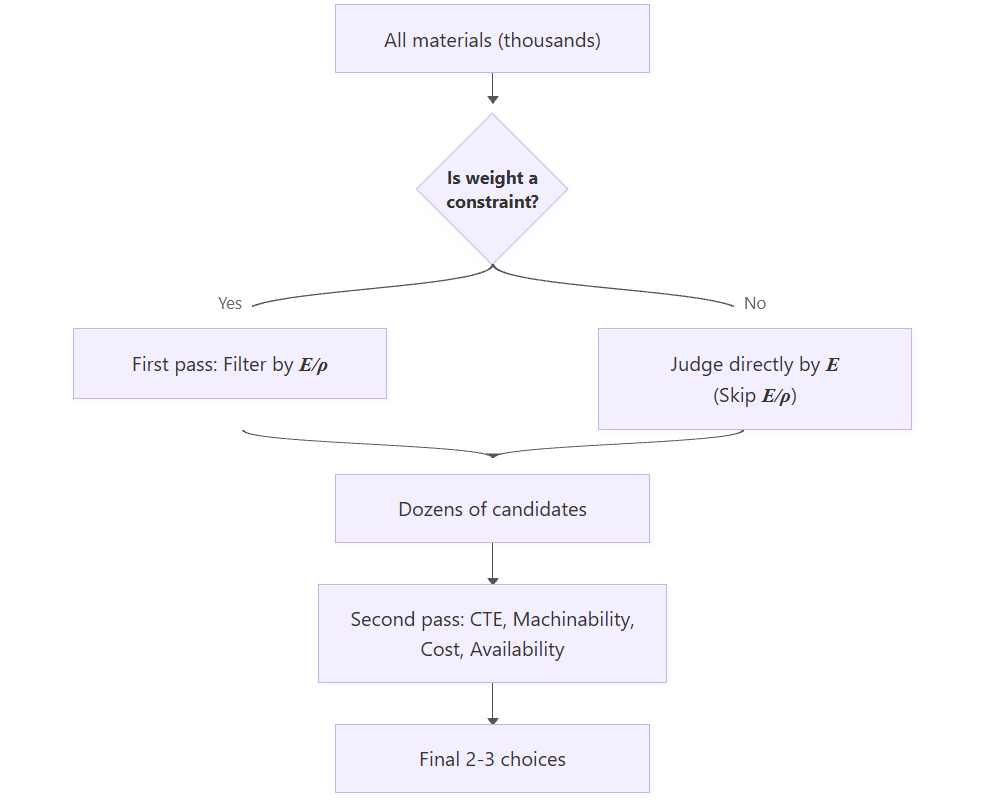
Figure 4: Where specific stiffness fits into the material selection process—it acts as the initial rough filter, rather than the final verdict.
4.2 The Core Yardstick for Lightweight Design
For structures with strict weight limits (spacecraft, aerospace components, highly dynamic motion stages), specific stiffness directly dictates "how much stiffness you can buy for a given weight." The logic flows as follows [1]:
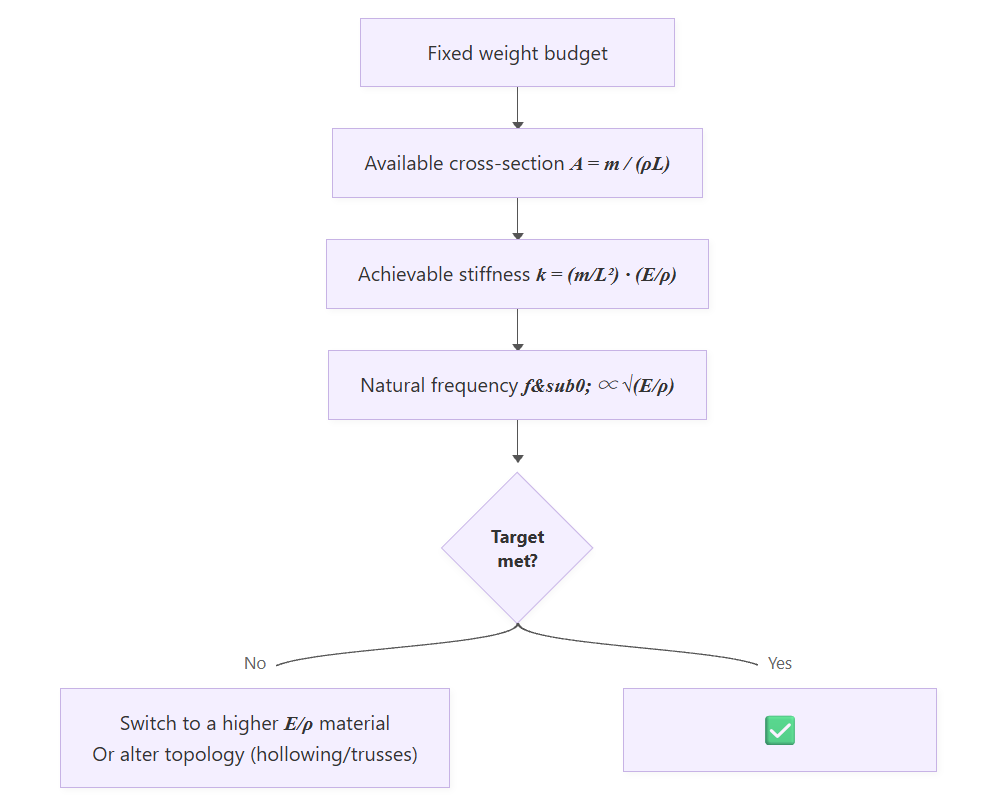
Figure 5:The logic behind lightweight design under weight constraints—with E/ρ serving as the core yardstick throughout the process.
4.3 A Bridge to "Material-Mechanics" Intuition
Memorize these baselines, and you can make snap judgments:

Part V. The Boundaries: When NOT to Use Specific Stiffness
Specific stiffness is not a magic wand. In the following three scenarios, relying on E/ρ is fundamentally wrong.
5.1 When Cross-Sectional Dimensions are Fixed (Not Weight)
If area A is locked by spatial constraints—for instance, you must use a standard 30×30 aluminum profile, or the outer diameter is limited by an optical envelope—then:
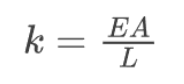
Since A is non-adjustable, stiffness k is strictly proportional to E, independent of ρ. Judge by pure E alone. Dragging E/ρ into this is mathematically redundant.
Contrast:
Cross-section A is freely scalable (Weight constraint) → Use E/ρ.
Cross-section A is locked (Space constraint) → Use E.
(This is the core principle of Ashby's material selection methodology [5]: the material index must match the design constraint).
5.2 When Weight is Unconstrained
For massive ground-based equipment (e.g., cast-iron bases for large CMM machines, or steel support frames for massive optical tables), weight is a non-issue. As long as stiffness targets are met, you are golden. In these cases, evaluate using E: pick the material with the highest E and simply bulk up the cross-section until it's stiff enough.
Using E/ρ under the wrong constraints is like using a thermometer to measure blood pressure—the tool isn't broken, but you're using it in the wrong scenario.
5.3 When Thermal Control Trumps Everything
Invar has a dismal specific stiffness of 17.5 (far below aluminum's 25.6) and is 3 times heavier. From a lightweight perspective, it finishes dead last. Yet, why is it used for the lens barrels in lithography objectives?
Because its CTE is 1.2 ppm/°C. Under the crushing constraint of sub-nanometer thermal stability, CTE reigns supreme. Weight and specific stiffness are entirely sidelined. This is a shift in constraint priority: Thermal Control > Lightweight → Invar wins.
Part VI. Summary of Core Formulas and Derivation Chain
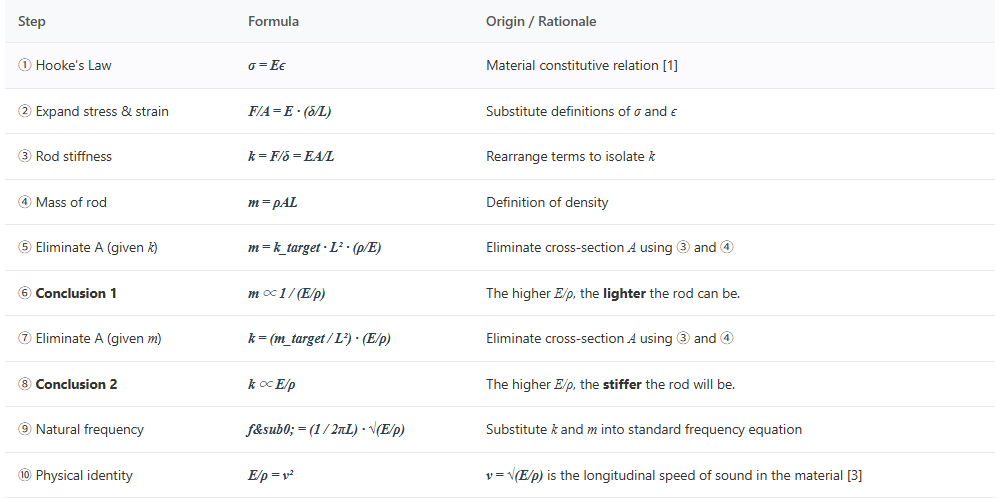
Conclusion
Specific stiffness is not an arbitrary definition. It naturally emerges from Hooke's Law (σ = Eε) and mass (k = EA/L and m = ρAL). When the cross-sectional area A is allowed to scale freely with material choice, E and ρ couple together, leaving only E/ρ in the objective function.
The ultimate identity of E/ρ is its relation to natural frequency: f₀∝√(E/ρ). All geometric parameters vanish under the square root. It is the only dynamic metric entirely divorced from geometry, relying purely on the material itself. This beautifully explains why steel and aluminum share nearly identical natural frequencies.
E/ρ only applies when weight or dynamic performance (f₀) are strict constraints. If the cross-section is fixed → use E. If weight is unrestricted → use E. If thermal stability is the priority → CTE takes over. Applying this metric to the right scenario is vastly more important than just calculating it correctly.
References
1.Yoder, P. R., Jr. & Vukobratovich, D. Opto-Mechanical Systems Design, 4th ed. CRC Press, 2015. — Chapter 6: Material property comparisons; Chapter 8: Application of specific stiffness in lightweight design.
2.Vukobratovich, D. & Yoder, P. R. Fundamentals of Optomechanics. CRC Press,2018. — Chapter 5: Relationship between material specific stiffness tables and natural frequency.
3.Meyers, M. A. & Chawla, K. K. Mechanical Behavior of Materials, 2nd ed. Cambridge University Press, 2009.— Chapter 1: The physical relationship between elastic wave speed and E/ρ.
4.Bely, P. Y. The Design and Construction of Large Optical Telescopes. Springer, 2003. — Chapter 5: Specific stiffness comparison of materials for large mirrors; Chapter 7: Lightweight mirror blank design.
5.Ashby, M. F. Materials Selection in Mechanical Design, 5th ed. Butterworth-Heinemann, 2017. — Systematic methodology of Material Indices. Derivation of specific stiffness as a performance metric under specific constraints.