
Target Audience: Optical Engineers, Mechanical Engineers, Systems Designers
Core Objective: Understand why optomechanical systems fail in real-world environments and master the "Opto-Mechanical-Thermal" integrated design mindset.
Prologue: A Classic Case of "Perfect on Paper, Disastrous in Practice".
You have probably heard this story—or perhaps even lived it:
An optical system performs absolutely flawlessly in the lab. Its MTF (Modulation Transfer Function) curve hits every target, and the resolution is razor-sharp. Yet, the moment it is integrated into a satellite payload and subjected to random vibration tests—or simply exposed to day-night temperature swings—the image quality drastically degrades. You get defocusing, astigmatism, or a system that completely fails to focus. You double-check all the alignment logs and retighten every screw, but the ghost in the machine remains.
So, where did it all go wrong?
Paul Yoder and Daniel Vukobratovich pinpointed the exact answer in the opening pages of their definitive work, Fundamentals of Optomechanics [1]: The "perfection" of an optical system in a lab is merely a static snapshot taken in a highly controlled environment.
In the real world, a harsh cocktail of vibrations, shocks, thermal gradients, vacuums, and material aging attacks this fragile equilibrium from multiple dimensions simultaneously. If you only focus on the performance metrics of a single discipline during the design phase while ignoring the coupling effects between them, everything you see in the lab is just a mirage.
This chapter will build your foundational analytical framework for optomechanical systems: what they are made of, how their subsystems interact, and why you must replace a "parts list" mentality with a "constraint network" mindset.
1. The Three Core Components of an Optomechanical System
An optomechanical system is far more complex than just "a lens shoved into a barrel." According to Yoder's classic breakdown in Opto-Mechanical Systems Design [2], the system consists of three interdependent, inseparable subsystems. Together, they form a closed coupling loop:
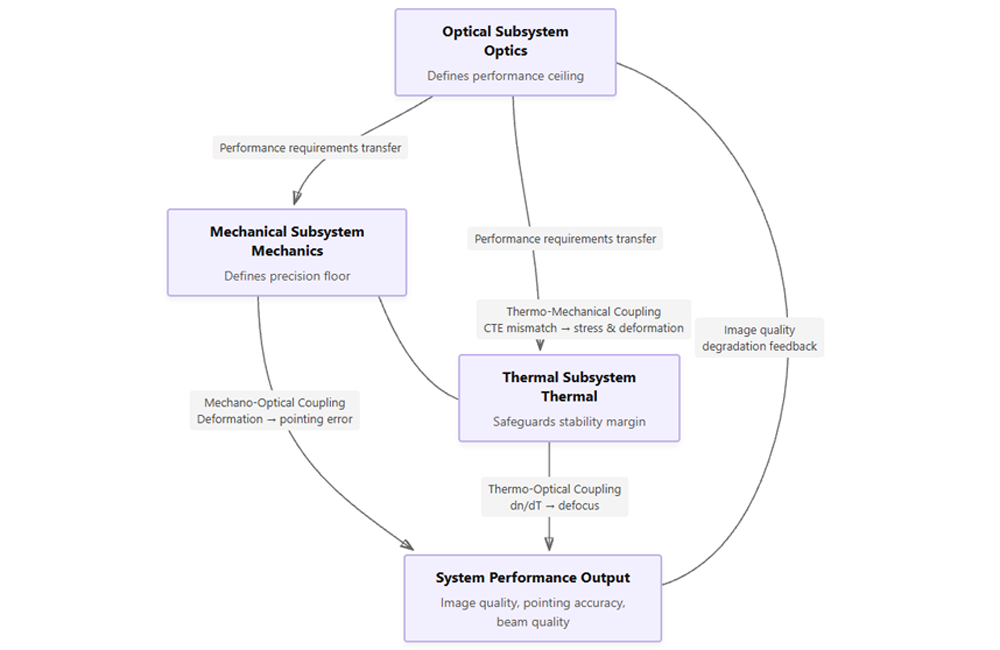
Figure 1: The coupling relationship of the three optomechanical subsystems (Adapted from the Doyle-Genberg-Michels integrated analysis framework [3])
Dividing a complex system into optical, mechanical, and thermal subsystems isn't just about breaking things down for the sake of it. We do this because these three disciplines operate on completely different physical laws, use different analytical tools, and chase different optimization goals. Yet, they all ultimately serve one master: the optical performance of the system. Understanding their respective roles is the prerequisite for grasping how they mess with—or support—each other.
Table 1: The Three Major Subsystems of Optomechanics
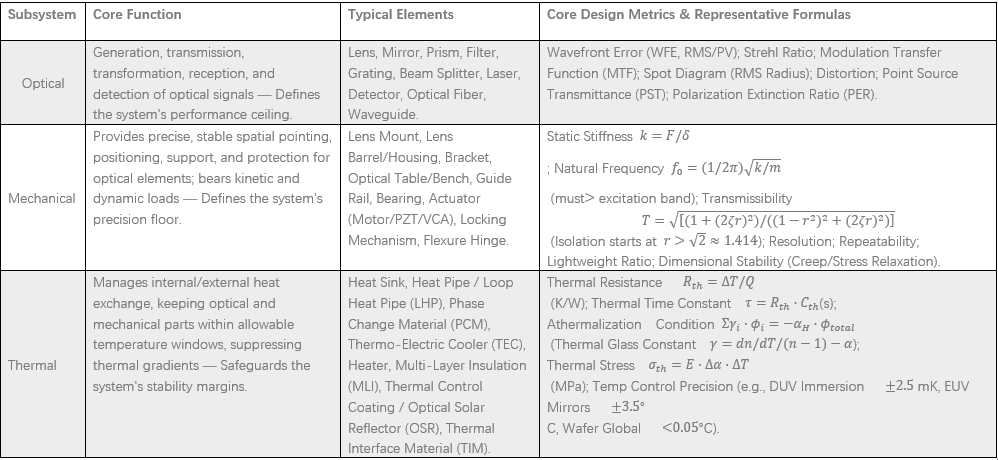
A Common Trap: "Design Optomechanics first, figure out Thermal later."
Many teams follow a linear workflow: (1)The optical engineer optimizes the design in Zemax ,(2)the mechanical engineer churns out blueprints in SolidWorks,(3) finally, they call in the thermal engineer to "help cool this thing down."
This is a textbook example of Isolated Design. The glaring flaw here is that once the optical and mechanical architectures are locked in, the thermal engineer is left with nothing but band-aid solutions—like slapping on heat sinks or adding fans. They are robbed of the chance to optimize at the root, such as selecting optical materials with a low, designing flexure mounts to release thermal stress, or reserving physical space for heat dissipation paths. The correct approach is to inject thermal constraints as primary design inputs right during the optical material selection and mechanical layout phases, not as an afterthought.
2. Opto-Mechanical-Thermal Coupling: The Physical Roots of Failure
Once we understand the three core components, the million-dollar question becomes: How do they interact?
This is Opto-Mechanical-Thermal Coupling. Doyle et al., in Integrated Optomechanical Analysis [3], define it as the core methodology for designing these systems. An external disturbance (often thermal) will propagate along multiple paths, eventually converging into the degradation of optical performance.
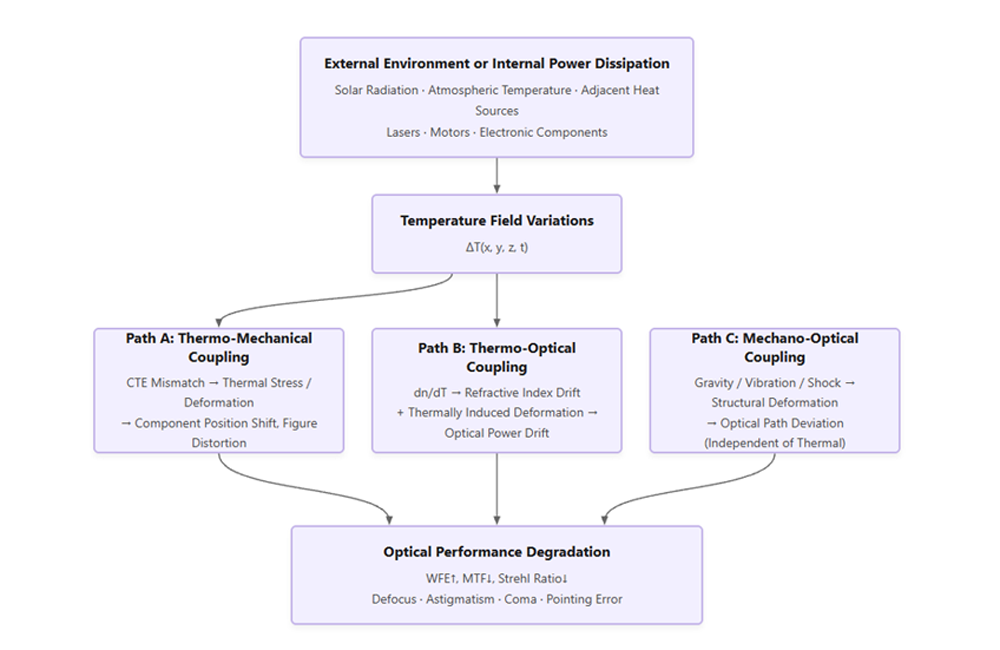
Figure 2: Opto-Mechanical-Thermal Coupling Paths (Based on Jamieson's athermalization framework [5] and Doyle's integrated analysis workflow [3])
Thermo-Mechanical Coupling
Driving Force: Mismatched Coefficients of Thermal Expansion (CTE) Thermal stress / Thermal deformation.
Key Formulas σ_th = E · Δα · ΔT.(Where E is the elastic modulus of the constraining part, Δα = α₁ − α₂, and ΔT is the temperature change).
Typical Magnitudes: If an aluminum alloy barrel (CTE23.6 ppm/℃) clamps a BK7 glass lens (CTE 7.1ppm/℃), a mere 20℃ drop in temperature generates roughly 45 MPa of compressive stress, pushing dangerously close to BK7's strength limit. If a stainless steel retaining ring (CTE 17.3) secures a fused silica lens (CTE 0.55), the Δα ratio is a staggering 31X.
Engineering Case: The primary mirror support for the James Webb Space Telescope (JWST) utilizes Invar (CTE 1.2 ppm/℃) to match its Beryllium mirrors (CTE ~11 ppm/°C),paired with flexure hinges to safely release thermal stress [6].
Thermo-Optical Coupling
Driving Force: Thermo-Optic Coefficient dn/dT(Thermo-Optic Coefficient)+ Thermally induced deformation dn/dT→ Optical power drift, defocus.
Key Formula: γ = dn/dT/(n−1) − α (Thermal Glass Constant).
Typical Magnitudes: For a BK7 lens (f=100mm, γ ≈ −4.0×10⁻⁶/K), a ΔTof 10°C causes the focal point to drift by about +5μm. Germanium (Ge), widely used in infrared applications, has a dn/dT of +369x10 ⁻⁶/°C, making it 100 to 400 times more thermally sensitive than visible light glasses [7].
Engineering Case: An infrared thermal camera will lose focus entirely within minutes of turning on if uncompensated, making Athermalization an absolute necessity. EUV lithography objective lenses use Zerodur glass (CTE ~0.02 ppm/°C) paired with active thermal control to suppress wavefront drift down to the sub-nanometer level [4].
Mechano-Optical Coupling
Driving Force: Gravity, vibration, shock → Structural deformation → Translation/tilt/rotation of optics → Optical path deviation.
Quantitative Relationship: Translation error Δz → Defocus; Δx/Δy→ Image shift; Tilt error θ → Beam pointing offset by 2θ.
Typical Magnitudes: A typical tolerance for a λ/10 RMS WFE is roughly ±5 μm in translation and ±10 arcseconds (") in tilt. For vibrations, interferometry setups are recommended to meet the VC-D criteria (RMS velocity < 6.25 μm/s across the 1/3-octave 4~80 Hz band) [8].
Engineering Case: Large space telescopes assembled and aligned on Earth under 1g gravity will experience "gravity release" upon entering orbit. The structure elastically rebounds, ruining the image quality. Engineers must conduct Gravity Release analysis and pre-compensate for this during assembly [6].
Deep Dive: Thermally Induced Deformation
Thermally induced deformation is the most easily overlooked link in thermo-optical coupling. It acts alongside dn/dT, but is frequently oversimplified or ignored in engineering analyses. The key to understanding it lies in distinguishing its four mechanisms:
1.Uniform ΔT, Free Expansion: The material temperature is uniform everywhere with no constraints → The element scales uniformly. The lens gets thicker, and its radius of curvature increases, shifting the focal length. This deformation is predictable and compensable (factored into the γ calculation). Pure scaling creates zero stress and does not alter the surface figure (shape).
2.Uniform ΔT, Constrained Expansion: The element wants to expand but is clamped → Internal thermal stress builds up → Non-uniform deformation occurs. If a lens is squeezed tightly by a metal ring, its surface figure twists, and RMS error skyrockets. Design Goal: Safely release thermal degrees of freedom (using flexure mounts or elastic rings) while maintaining positioning stiffness.
3.Thermal Gradient: Different parts of the element are at different temperatures → The hot side expands more than the cold side → A bending moment is created (the bimetallic strip principle). In optical systems, a top-to-bottom temperature difference of just 0.1℃ across a mirror can warp its surface by about λ/10 (approx. 63 nm at λ-633 nm).
4.Bimaterial Bending: Two materials with different CTEs glued or coated together (like a coated mirror or a cemented doublet) → When temperature changes, the whole assembly bends like a bimetallic strip. When lightweight mirrors are coated with thick films, CTE mismatch between the coating and substrate is a notoriously common cause of surface figure degradation.
Summary in one sentence: Thermally Induced Deformation = CTE × ΔT × Constraint Conditions.If any of these three factors approaches zero, the deformation vanishes. This is precisely why the combination of Low CTE materials (Zerodur, Invar) + Constant temperature control + Kinematic Mounts is hailed as the "Golden Combo" of precision optomechanical design.
3. From "Parts List" to "Constraint Network": The Integrated Design Mindset
The traditional mindset treats design like a "parts list"—breaking the system into independent functional blocks, building them one by one, and snapping them together at the end. This works fine for loosely coupled systems, but for precision optomechanics, it is a recipe for disaster.
The true core of integrated opto-mechanical-thermal design is building a Constraint Network. Every design decision is simultaneously a "receiver" of constraints from other domains and a "transmitter" of constraints to other domains. There is no such thing as "design first, check later"—constraints must be satisfied concurrently during the design process.
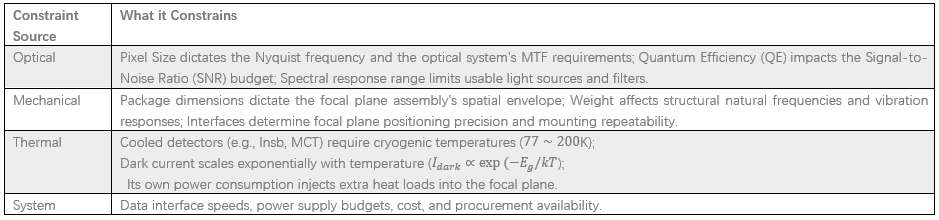
The Constraint Network for Selecting a Detector
Choosing a detector is not just a job for the optical engineer. It sits at the crossfire of four different disciplines:
The Constraint Network for Designing a Lens Barrel
The lens barrel is the ultimate "multi-disciplinary crossroads" in an optomechanical system. Staring solely at stiffness is never enough:
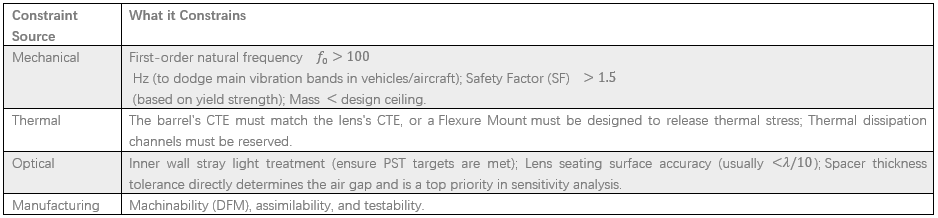
A Massively Underestimated Node: Alignment & Testing (A&T)
Vukobratovich and Yoder [1] emphasize this repeatedly: "What you design is what you must be able to measure." Countless brilliant "paper designs" have died because they were impossible to assemble or measure in real life.
A notoriously easy mistake to make is failing to define physical Datums for optical alignment during the mechanical design phase. The correct move is to machine three precision dowel pin holes at 120° apart on the barrel or baseplate, or to use standard optical table interfaces. This ensures the module has a Repeatable Datum throughout the entire alignment, testing, and integration lifecycle. Without this, every disassembly introduces micron-level optical axis drifts, turning your debugging process into a bottomless pit.
4. Case Study: Integrated Design of an Industrial Lens
Let's look at a Fixed Focal Length Machine Vision Lens to see how this Opto-Mechanical-Thermal constraint network operates in a real product.
Assumptions: Operating environment 0~45°C; Optical design is a 4-element in 3-group structure, including one ED (Extra-low Dispersion) glass element to correct chromatic aberration.
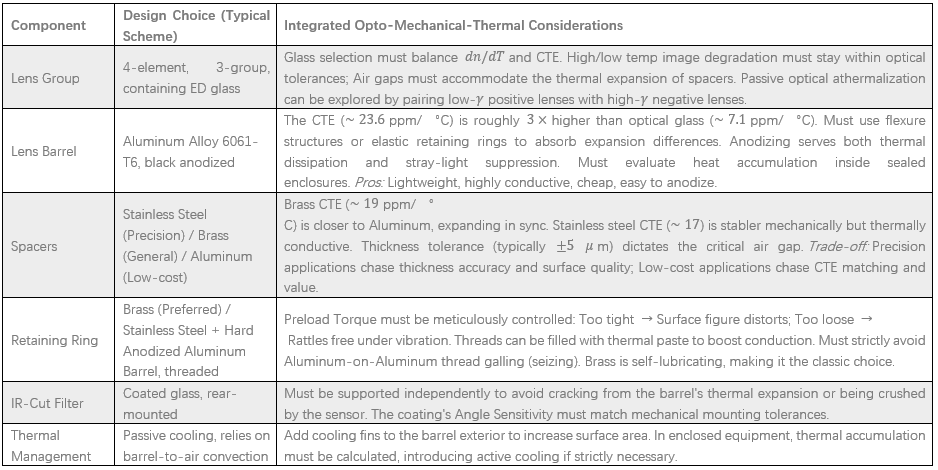
The takeaway from this case is clear: Even for a seemingly simple industrial lens, design is a highly interconnected systems engineering challenge. Whenever you design a part, you must simultaneously answer three questions:How does this affect optical performance?How does this affect mechanical stability?How will this behave under thermal loads?
5. Quick Reference Formulas
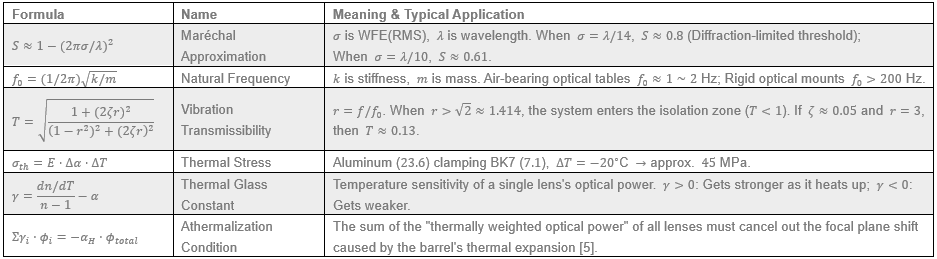
Chapter Summary
Once you understand the composition and coupling relationships of these three subsystems, you possess the universal language required to alyze any optomechanical design problem.
Key References
Vukobratovich, D. & Yoder, P. R., Jr. Fundamentals of Optomechanics. CRC Press, 2018. — The foundational textbook for optomechanics, covering engineering guidelines for materials, stiffness, modal analysis, and mounting design. Excellent for beginners.
Yoder, P. R., Jr. & Vukobratovich, D. Opto-Mechanical Systems Design, 4th ed., Vol. 1 & 2. CRC Press, 2015. — The undisputed core reference in the field. Chapter 5 (Athermalization) and Chapter 8 (Lens Mounting) are legendary.
Doyle, K. B., Genberg, V. L. & Michels, G. J. Integrated Optomechanical Analysis, 2nd ed. SPIE Press, 2012. — The methodology bible for integrated opto-mechanical-thermal analysis, defining the standard workflow for mapping FEA results to optical performance. (Chinese translation published by National Defense Industry Press).
Li, Z. et al. "Thermal Control Systems in Projection Lithography Tools: A Comprehensive Review." Micromachines, 16(8), 880, 2025. — A comprehensive review of thermal control in lithography systems, detailing precision requirements and methodologies for each subsystem.
Jamieson, T. H. "Athermalization of Optical Systems." SPIE Critical Reviews, Vol. CR43, 1992. — The original derivation of the three-equation system for athermalization, remaining the theoretical bedrock to this day.
Bely, P. Y. The Design and Construction of Large Optical Telescopes. Springer, 2003. — A classic on large telescope systems engineering, covering gravity release, thermal control, and active optics.
Schott AG. Optical Glass Data Sheets. — The gold-standard data source for optical glass dn/dT、CTE、γ values.
Amick, H. et al. "Evolving criteria for research facilities: vibration." Proceedings of SPIE, Vol. 5933, 2005. — The engineering background and quantitative basis for the VC vibration criteria curves (A~G).
Born, M. & Wolf, E. Principles of Optics, 7th ed. Cambridge University Press, 1999. — The theoretical optics bible. See Chapter 9 for the rigorous derivation of wavefront aberrations and the Strehl Ratio.
Munnig Schmidt, R. H. et al. The Design of High Performance Mechatronics. Delft University Press, 2011. — Textbook on precision mechatronic design from TU Delft, Netherlands; a vital academic wellspring for ASML's lithography design methodologies.
Schwertz, K. & Burge, J. H. Field Guide to Optomechanical Design and Analysis. SPIE Press, 2012. — A handy pocket guide, featuring quick-reference tables for material CTE, E, and ρ.
Quiz Time
True or False
When designing an optomechanical system, as long as the optical targets and mechanical strengths are met, thermal control can be figured out after the design is finalized.( )
"Thermo-Optical Coupling" refers to temperature changes causing mechanical structures to deform, which in turn affects the optical path.( )
When selecting materials for a lens barrel, in addition to stiffness and weight, you must also consider whether its Coefficient of Thermal Expansion (CTE) matches the lens material.( )
Answers: 1 (False), 2 (False), 3 (True)